Get Involved!

If you are interested in submitting a piece of work to be published on this blog, please email criminologyonthestreets@gmail.com.
Views are strictly those of the individual author.

Monday, November 4, 2013

Enough with the politicized knee-jerk response to selective interpretation of Youth Offending Statistics.

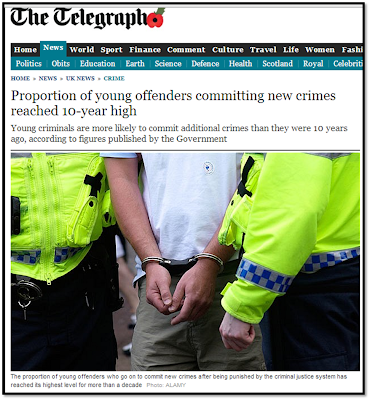
 According to David Barrett, who is a Home Office Correspondent for The Telegraph Newspaper, the “proportion of young offenders committing new crimes reached a 10-year high” (October 31, 2013)


 Telegraph Article
Mr. Barrett is correct when he reports that recently published data from the Ministry of Justice (MoJ) has identified a 2% increase in re-offending rates since 2000 leading to the highest percentage of offenders re-offending. The response from the Justice Secretary, Chris Grayling, is that the 2% increase is evidence that his “payment by results” reform proposals should be taken into serious consideration. This reform will create contracts with private companies and charities who will work with less serious offenders. These companies will only be paid in full if they achieve the targets set to reduce re-offending. 

What Mr. Barrett and Mr. Grayling are neglecting to mention, is the fact that the overall youth offending and custody rates are currently at an all-time low. With such a small youth offending cohort, it is not surprising that the percentage of re-offending rates has increased slightly. It could be argued that those who are still in the system are young offenders who are considered the most serious and challenging; thus, we would predict they would be the most likely to re-offend. Simply put, if your cohort has reduced and primarily includes only serious and violent offenders,  your statistics of re-offending will naturally increase. The fact that they have only increased by 2% is actually a positive given the offending nature of those currently involved in the youth justice services.

Taking a closer look at the statistics provided by the MoJ, it was reported that overall there were 137,335 proven offences by young people in 2011/12, which is a decrease of 22% from 2010/11 and a decrease of 47% since 2001/02. This overall reduction includes a reduction in criminal damage (-28%), public order (-27%), theft and handling (-23%), and violence against the person (-22%). Furthermore, while the rates of re-offending has increased 2% since 2000, the rates of 'First Time Entrants' (FTEs - first reprimand, warning, caution or court conviction) has fallen 20% since 2010/11 and an impressive 59% since 2001/02. 

(click to enlarge image)
With regards to the total number of young people receiving sentences, there were 66,430 in 2011/12 which is another reduction of 22% since 2010/11 and 48% since 2008/09. This decrease is the result in the fall of FTEs.

As proposed above, while the overall number of young people involved in the justice system has fallen, those who are involved could be identified as more serious and challenging offenders. In 2011/12, the majority of proven offences were committed by young people aged 15+, with only 25% committed by those aged 10-14. However, this year is the first time in 10 years that the average custody population has fallen below 2,000 (1,963) with a dramatic 30% reduction since 2001/02 (2,801). Although violence against the person has decreased by 22% (as stated above), it is one of the most common offence types amongst young offenders in custody, supporting the argument that the current cohort of young offenders are the offenders who would be considered the most challenging.  
(click to enlarge image)


The breakdown of primary offence types indicates a high proportion of serious and violent offences. This year, 27% of young people were in custody for robbery offences, and 21% for violence against the person. Again, supporting the argument that the current population now consists of young offenders who are most serious and challenging which would increase the statistics of re-offending; not because of the failure of the justice system. In fact, based on the significant decreases in overall offending and custody rates, it could be argued that the current system is doing exactly what it is meant to do.


Overall, the politicized statement given in the above article is questionable given the fact that “in 2000, there were 139,326 young people that formed the re-offending cohort, in 2010/11 the size of the re-offending cohort had fallen 37% to 88,357...this suggest that young offending teams are working with a smaller but generally more prolific cohort” (MoJ, 2013). Making these generalized statements that “re-offending is the highest it’s been in a decade” and that we need to seriously consider “payment by result” rehabilitation methods is a very narrow minded response to the published statistics and needs further investigation. This type of politicized response is not taking into consideration the demographics and risk-factors of those who are not included in the small but serious offending cohorts. Enough with the politicized knee-jerk response to selective interpretation of Youth Offending Statistics. 


A. Neaverson 

Monday, April 8, 2013

“It’s not long enough” – Mick Philpott, Sentencing Policy, and Public Criminology - Craig Harper


“It’s not long enough” – Mick Philpott, Sentencing Policy, and Public Criminology


Last week saw the sentencing of Derby man Mick Philpott, his wife Mairead, and friend Paul Mosley for the manslaughter of the Philpott’s six children in a house fire last May.  The story has naturally captured the public’s imagination and bought to the fore several debates about the UK’s approach to sentencing and the Welfare State.  In this post, I try to unpack some of the pertinent issue and address some of the misconceptions being reinforced by recent press reporting of this case.

The Manslaughter of Six Innocent Children

Mick Philpott’s living arrangements – unemployed and living with two different women, along with 11 children – have been widely publicised and commented on.  His wife, Mairead, and his lover Lisa Willis, took it in turns to sleep with him in their caravan on alternate nights, and this was covered in a 2007 edition of The Jeremy Kyle Show – a ‘reality TV’ programme that is tantamount to human bear-baiting, designed to put some of Britain’s most desperate people on television, playing out their out-of-control lives for the satisfaction and pleasure of those in more fortunate, if not perfect, positions.

When Lisa Willis left the home last February, Mick Philpott sought to reclaim her presence (and her child benefit money) through a host of different strategies, such as “sweet talking … cajoling … and bullying”, according the Mrs Justice Thirlwall’s sentencing remarks.  When she didn’t he hatched a wicked plan in order to blame her for a crime she didn’t commit – that of arson against her former family home, such that she would be prosecuted and Mick would obtain custody of the five children with whom Lisa left.

Mick Philpott was responsible for dousing his hallway in petrol and setting it alight.  The Crown accepted that he had not intended to kill his children, or even to cause them significant physical harm, and subsequently charged the three co-defendants with manslaughter as opposed to murder, with the assertion being that Mr Philpott had planned to enter the house, rescue the children, and be considered a local hero.  This unfortunately went horribly wrong, no rescue attempt was possible, and the six children inside tragically died.

Sentencing policy

Many people have commented on the sentence being handed down to these offenders – particularly the one given to Mick Philpott.  The sentences passed were as follows:
 
  • Mick Philpott – Life imprisonment with a minimum term of 15 years
  • Mairead Philpott – 17 years imprisonment
  • Paul Mosley – 17 years imprisonment

These sentences, when set against the context of the unlawful killing of six innocent children, have been described as too lenient by some members of the public, with others on the social networking site Twitter calling for a reintroduction of capital punishment for child killers. 

However, it should be noted that the judge, Mrs Justice Thirlwall, passed the maximum sentence possible for manslaughter.  Life imprisonment is the most severe punishment available for this index offence and, in setting the minimum tariff to be served by Mick Philpott, she stated:

The law requires me to impose a period of years that you will serve before you are considered for parole. To reach that period I must identify the determinate sentence you would have served had I not imposed a life sentence. The determinate sentence would have been one of 30 years’ imprisonment. I am required by parliament to halve that to reflect that were this a determinate sentence you would serve only half. The minimum period you must therefore serve before you are considered for parole is one of 15 years. From that I deduct 307 days to reflect the time you have already served on remand to give a term of 14 years and 58 days. Whether or not you are ever released will be a matter for the parole board.

Whole-life sentences, whereby “life means life” and there is no possibility for parole, is one option being mooted as a compromise between life sentences and the death penalty.  This case is certainly one that shakes my own personal beliefs, but I reassert that the idea of whole-life tariffs raise some serious concerns.  My view of prisons is that they should be fundamentally places for reformation and rehabilitation.  I have written previously that only the most dangerous criminals should be given prison terms (a theory supported by the risk-need-responsivity model of offender rehabilitation) – and that it is only by doing this that you can focus on doing intensive therapeutic work without passing on “tricks of the trade” to lesser criminals, such as those with acquisitive or public order offences.

Politically, though, it is wise for the Government to continue the trend of increasing the number of prisoners serving long or whole-life sentences.  This satisfies a certain Lombrosian culture that seems to fester in the vast majority of criminal justice rhetoric in the UK, and the concept of whole-life sentences seems to support this ideology by suggesting that some violent offenders are beyond help.

Another important point to raise is that, if a prisoner knows there is no chance of release, what do they have to lose?  They may as well behave however they like, and, with few opportunities for rehabilitation (why waste money of offending behaviour programmes on those beyond help?), prisoners on whole-life sentences have the perfect excuse to take their frustrations out on other inmates, or indeed police officers.  The press would no doubt report these incidents as ‘proof’ that these “beasts” should be locked up for the rest of their days – but they actually contribute to these events.

There have also been complaints about the fact that, if their sentences run as planned, Mairead Philpott and Paul Mosley will be “out in 8 years”.  Whilst it is true that these two will be released from prison-based custody at the half-way point of their respective 17 year sentences, it is not the case that they will be completely free, as some media outlets and commentators would lead you to believe.  Any offender that is released prior to the end of their allotted tariff  must serve up until the end of their sentence on licence – where they are still subject to strict sanctions which, if broken, could still lead the to be recalled to prison.  This licence period lasts until the end of the originally passed sentence (or for life, in the case of a life sentenced prisoner), and is accompanied by a variety of restrictions, including curfews and electronic tagging.  To suggest that those on licence are as free as the rest of us is a misleading fallacy.

Conclusions

All in all, I feel that the sentences passed are fair, and take into account the varying factors relating to each individual defendant.  Mick Philpott is clearly a controlling and callous individual with his own self-interest at the heart of everything he does, and the fact that he has received the maximum possible sentence for his actions is absolutely right. 

My only hope is that those involved in criminology and criminal justice engage better with the public and the media to allow for more balanced, evidence-based, and factual accounts of the sentencing process to be produced.


Craig Harper is a postgraduate student of forensic psychology based at the University of Lincoln, UK.  His research interests lie in desistance from crime, offender reintegration and public criminology.

Visit his website at http://lincpsychuk.wordpress.com.

Thursday, December 13, 2012

Hate Crimes; What is the real number?

Hate Crimes; What is the real number?

Date of publication: 23th October 2012

A hate crime is any criminal offence committed against a person or property that is motivated by hostility towards someone based on disability, race, religion, gender identity or sexual orientation.

According to the BBC NEWS UK more than 2000 such offences were recorded in 2011, up one third from 2010. Police have said this was partly due to an increased willingness to report crimes. Overall hate crimes linked to race religion sexual orientation and disability fell by 3600 to 44,500. Hate crime monitoring began in 2008 to raise awareness of the problem. In 2011 a total of 44,519 hate crimes were recorded compared with 48,127 in 2010.

According to the home office website I have found  there were 43,748 hate crimes recorded by police in 2011/2012. These figures are related to the five monitored strands of the hate crime classifications used by the criminal justice system and is not a count of crimes as more than one form of hate crime can be assigned to an offence. Indicative data suggest that less than 5% of hate crime offences have more than one monitored strand assigned ( this ranged between 1% and 7% of offences for the 17 forces whose data was reviewed).
Of the 43,748 hate crimes recorded by police:

  • *35,816 (82%) were race hate crimes
  • *1621 (4%) were religion hate crimes
  • *4252 (10%) were sexual orientation hate crimes
  • *1744 (4%) were disability hate crimes
  • *315 (1%) were transgender hate crimes.

There is a  discrepancy in numbers by 751 hate crimes. I’m not sure what database the BBC NEWS got there information from;  maybe different from the home office?  Is that why there is a slight difference in numbers? What I have noticed is the home office seems to have broken down the statistics so we as a public get an actual over view of what a hate crime is and how the statistics are going down slightly. If anyone has any information regarding this discrepancy in numbers, please comment below.


Year 1 Student – Crime & Investigative Studies
University Centre Peterborough
Supervisor: A. Smith; B.A. (Hons) Criminology Course Leader


Media Reports of Police Opinions


Media Reports of Police Opinions

I am a student at University Centre Peterborough and I wanted to ask a question regarding the validity of research discussed by the media. I looked into an article that discussed police opinions with regards to being armed on duty and it seems the article published by the BBC is misrepresenting information.

According to an article on http://www.bbc.co.uk/news/magazine-19641398 a 2006 survey of 47,328 police federation members found that 82% did not want officers to be routinely armed on duty. However, upon further investigation I found the information was not a yes or no question but a multiple choice response. I am wondering where the 82% came from, as this is the information I found on - POLICE FEDERATION OF ENGLAND AND WALES SURVEY OF MEMBERS 2006 – TOP-LINE REPORT.


Year 1 Student – Crime & Investigative Studies
University Centre Peterborough
Supervisor: A. Smith; B.A. (Hons) Criminology Course Leader


Sunday, November 18, 2012

Proving Domestic Violence - Free Guest Lecture

"Proving Domestic Violence"


University Centre Peterborough is hosting a FREE public lecture on December 3rd to discuss the difficulties of prosecuting Domestic Violence cases. Guests will start to arrive around 6:30pm with the lecture scheduled to begin at 7:00pm. Refreshments will be provided. Please ring the number below and book your place! 


This talk is from the perspective of a practising Crown Prosecutor about the complex challenges posed by Domestic Violence related prosecutions. What is it like to prosecute cases of this type? What happens if the victim does not support the prosecution? Can a case progress without the support of the victim? If so; how? And importantly; why?

Friday, October 26, 2012

Evil Exists Only in the Eye of the Beholder. Scott Bonn, Ph.D.


Evil Exists Only in the Eye of the Beholder.


                        Scott Bonn, Ph.D.

 
Evil is not a universal truth.  It is a socially constructed concept and it only exists in a particular time and place.  This perspective on evil, known as social constructionism, is rooted in the philosophical writings of Immanuel Kant.  According to Kant, matter does not exist in its own right.  Instead, all matter is a product of the mind.  Because all objects are constructed of matter, all objects are thus mental creations. 

Social constructionism emerged over the past forty years as a sociological theory of knowledge that considers how social phenomena develop in particular social contexts.  According to this perspective, all knowledge, including the most basic, taken-for-granted common sense knowledge of everyday life, is actually constructed and reinforced through social interaction.  Social constructionists see reality as a dynamic and constantly contested process—that is, reality is reproduced by people acting on their knowledge and their socially constructed interpretations of it.       

As a logical extension, social constructionism contends that social problems do not exist objectively like a mountain or a river.  Rather, they are constructed by the human mind, socially created or constituted by the definitional process.  Therefore, the objective existence of a harmful condition such as a disease does not, in and of itself, constitute a social problem.  From the social constructionist perspective, an objective condition does not constitute a social problem unless it is defined as such by the members of a society in a particular context.  Moreover, an objective condition does not even have to exist to be defined as a problem.  That is, if something is thought to exist and it elicits fear, then it is real despite the fact that it does not exist objectively.  The witch hunts in colonial New England are an example of a non-objective, socially constructed crisis.  From a constructionist perspective, what makes a condition a social problem is the degree of felt concern by a society about that condition, regardless of whether it actually exists or whether it is objectively harmful. 

            Significantly, an analysis of the social construction of evil provides an understanding of the processes and mechanisms by which those in power and authority in society can demonize a particular group and establish an evil identity for it in the public consciousness.  The word evil itself has a long linguistic history.  The Oxford English Dictionary attributes the original derivation of the word evil to the Goths of the 4th century A.D. who defined it as “exceeding due measure” or “overstepping proper limits.”  Webster’s College Dictionary defines evil as “morally wrong or bad; immoral; wicked; harmful or injurious; due to actual or imputed bad conduct or character; evil quality, intention or conduct.”  I contend that the definitions of evil are all socially constructed and socially defined in particular contexts.  In other words, behaving evilly, producing evil and being evil are radically social processes which are defined in a given social context or time and place. 

The definitions of evil are also tautological—that is, the definitions involve circular reasoning.  One may be labeled as evil because one does evil things, and if one does evil things, then one is evil.  This tautology is problematic because a circular argument cannot be tested or falsified.  As a result, the tautological definition of evil can be exploited by those who apply the label of evil to an individual or group.  How?  If the labelers’ arguments cannot be falsified, then their claims are not subject to meaningful debate or critique by skeptics.  Once a disvalued individual or group is socially defined as evil, those in power have the moral authority and even obligation to eliminate the evildoer(s) regardless of whether or not there is an objective threat to society. Therein lies the danger in the social construction of evil.  It certainly didn’t matter that those who were convicted of witchcraft in colonial New England were not actually witches at all.  They were sentenced to death and executed, nonetheless.  It is important to remember this powerful historical lesson.  When we apply the label of evil to a disvalued individual or group without proper inquiry, the consequences can be dire.  

Dr. Scott Bonn is Professor of Sociology and Criminology at Drew University and a media expert.  He is the author of the critically acclaimed book “Mass Deception: Moral Panic and the U.S. War on Iraq” and is currently writing a book about finding hope and redemption behind prison walls.  Follow him @DocBonn on Twitter and visit www.docbonn.com


Sunday, October 21, 2012

The 'NEW' Crime Survey of England and Wales A.Smith

Changes in the Publication of Crime Statistics in England and Wales 

A.Smith

For researchers, students, and members of the public, it use to be the case that you rely on the British Crime Survey produced by the Home Office to find out current trends and issues relating to Crime in England and Wales. As of April 1st, 2012, this has changed and a separation between the Home Office and Criminal Statistics has been established; the collation and publication of crime statistics has moved to the Office for National Statistics.

In December 2010 the Home Secretary announced that the publication of Crime Statistics covering England and Wales would be moved out of the Home Office to promote greater public trust and demonstrate their independence. The Home secretary invited the National Statistician to conduct an independent Review of Crime Statistics for England and Wales to:
  •           Consider gaps, discrepancies and discontinuities within crime statistics;
  •           Recommend the best future location for the publication of crime statistics, and their associated data collection systems; and
  •           Produce an action plan for the implementations of recommendations from the UK Statistics Authority’s report Overcoming Barriers to Trust in Crime Statistics: England and Wales published in May 2010.

National Statistician, Jil Matheson, led the independent review of official crime statistics for England and Wales. The National Statistician – a statutory office holder – is also the Chief Executive of the UK Statistics Authority Board and the Board’s principal adviser. She is also the Head of the Government Statistical Services (GSS) which is a network of professional statisticians and their staff operating both within the Office for National Statistics and across more than 30 other government department and agencies.

 As indicated in a News Release (June 2011) from the Government Statistical Service, key findings of Ms. Matheson’s review are that:
  •         The Office for National Statistics (ONS) should assume responsibility for the independent reporting and publication of crime statistics;
  •         The presentation of crime statistics needs further improvement to provide clarity about the coverage of the two sources of crime statistics – the British Crime Survey and police recorded crime – and to maximise the benefits of complementary sources to provide a fuller picture of crime; and
  •       There should be transparent decision-making on changes that affect the published crime statistics.

Ms. Matheson reported that the recommendations of the independent review are designed around improving the public’s understanding of crime statistics and their confidence in them.

(For detailed information regarding the recommendations set by the National Statistician see HERE 

The Crime Statistics Advisory Committee

This is a non-statutory body established by the National Statistician following a recommendation from the review. The committee functions as a strategic, high level advisory body offering independent advice to the Home Secretary, the Office for National Statistics (ONS) and Her Majesty’s Inspectorate of Constabulary (HMIC) on matters related to the measurement of crime and the collection and presentation of crime data for England and Wales. It advises on how best to ensure that official statistics on crime are accurate, clearly presented, comprehensive, transparent and trustworthy taking account of the needs of users and providers. The current chair of the committee is Professor Stephen Shute – Head of the School of Law, Politics and Sociology and Professor of Criminal Law and Criminal Justice, University of Sussex.

What is ‘The Crime Survey for England and Wales’?

The British Crime Survey and police recorded crime measure different but overlapping issues of crime in England and Wales. They measure people’s experience of crime, and crimes report to, and recorded by the police. The new crime statistics report will now be called The Crime Survey for England and Wales (formerly British Crime Survey) asks people aged 16 and over living in households in England and Wales about their experiences of crime in the last 12 months. These experiences are used to estimate levels of crime in England and Wales. Until recently, the survey did not cover crimes against those aged under 16, but since January 2009 the interviews included children aged 10 to 15.
The Crime Survey also asks respondents about their attitudes to crime-related issues such as:
  •           The Police
  •           The Criminal Justice System
  •           Their perceptions of crime and anti-social behavior.
The results of the survey play an important role in informing government policy.

The Crime Survey for England and Wales provides a better reflection of the extent of household and personal crime than police recorded statistics because the survey includes crimes that are not reported to, or recorded by the police. The survey is also a better indicator of long-term trends because it is unaffected by changes in levels of reporting to the police or police recording practices.

It is important to remember that there are limitations within the Crime Survey and that it does not provide an absolute count of crime.


Information has been taken from the following government websites.